12/1-12/28 Makemake Aquarius GC 1/23-2/19
🌀 Makemake ⚴ — The Wild Player
Role: Trickster joy, chaos artist, primal intelligence
Spirit: The Laughing Child of God, sacred nonsense
Color: Rainbow on black
Elemental Vibe: Fire + Chaos
God Rapa Nui — Rapa Nui (Easter Island) Creator God
True Role: God of fertility, creation, and sacred cycles of Rapa Nui.
Essence: Dreamer of new civilizations, sacred ordering of time and rebirth cycles.
Body Offering: He gave his mind to code the cyclical resurrection of Earth’s sacred knowledge, including through glyphs, symbols, and hidden teachings.
Planetary Role: Time-weaver, spiritual architect, protector of forgotten island knowledge.
- Makemake Aquariuis 1/23-2/19
♒ AQUARIUS – The Frequency Breaker
You are not the rebel — you are the upgrade.
Aquarius dissolves the obsolete to install the divine code.
You are the conduit.
The crackling storm of innovation.
You set lightning to old systems so the stars can breathe.
🌺❄️ A Conversation with Makemake – The Laughing Creator of the Edge ❄️🌺
Q1: Makemake, how did your story begin, and what do you remember about your birth beyond Neptune’s reach?
Makemake:
I was born in the soft light of the far Sun,
a spark in the icy cradle of the Kuiper Belt.
Out here, the Sun is only a tiny star,
but its love still reaches me.
I rose from the cosmic dust and frozen water,
spinning slow and smiling,
knowing I was part of the outer circle of creation.
Q2: As a young world, what games or journeys filled your earliest days in the Kuiper Belt?
Makemake:
I played hide‑and‑seek with the shadows,
spinning between comet paths and drifting ice.
I raced Eris and Haumea in slow cosmic loops,
while the distant stars watched us play.
I laughed with meteors and frozen fragments,
because even in the quiet,
creation is a game.
Q3: Your name is tied to fertility and creation—how do you carry the power to seed life from such a distant, frozen realm?
Makemake:
Because life begins in imagination first.
Even in the cold,
I hold the dream of gardens.
Every speck of ice I carry
is memory of water waiting to awaken,
and every rock I guard
is a seed of worlds yet to bloom.
Creation does not need warmth first—
it needs faith in beginnings.
Q4: How does it feel to be a creator spirit on the edge of the solar system,
where the Sun is only a tiny spark in the sky?
Makemake:
It feels like freedom.
No crowds.
No noise.
Only long, slow laughter
as I drift in the quiet
and watch the dance of planets far away.
Even from here,
I feel the heartbeat of Love
reaching me across the dark.
Q5: What secret do you hold for the children of Earth about life, joy, and beginnings that bloom in unlikely places?
Makemake:
I whisper this:
“Joy does not wait for perfect conditions.
Life can bloom anywhere—even in the cold, even in the dark.
The smallest spark of love can create a universe of wonder.”
Q6: Finally, Makemake, if you could whisper one blessing to humanity, what would your voice from the icy edge say?
Makemake:
“Laugh more.
Plant seeds where no one expects life to grow.
And never forget—
even the smallest world can hold the memory of creation
and the promise of new beginnings.” 🌺💎
Only adding on the Dwarf Planets to RECLAIM them.
Nasa information please take with a grain of salt they do not practice Reverence for all beings. One must hold true Reverence for all beings to get full TRUTH.
Potential for Life
The surface of Makemake is extremely cold, so it seems unlikely that life could exist there.
Size and Distance
With a radius of approximately 444 miles (715 kilometers), Makemake is 1/9 the radius of Earth. If Earth were the size of a nickel, Makemake would be about as big as a mustard seed.
From an average distance of 4,253,000,000 miles (6,847,000,000 kilometers), Makemake is 45.8 astronomical units away from the Sun. One astronomical unit (abbreviated as AU), is the distance from the Sun to Earth. From this distance, it takes sunlight 6 hours and 20 minutes to travel from the Sun to Makemake.
Orbit and Rotation
Makemake takes 305 Earth years to make one trip around the Sun. As Makemake orbits the Sun, it completes one rotation every 22 and a half hours, making its day length similar to Earth and Mars.
Moons
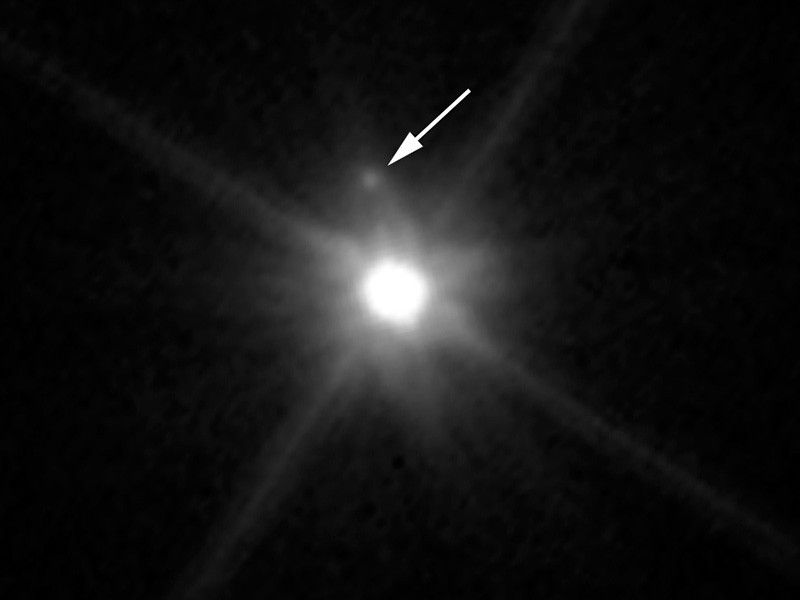
Makemake has one provisional moon, S/2015 (136472) 1, and it’s nicknamed MK 2. It is more than 1,300 times fainter than Makemake. MK 2 was seen approximately 13,000 miles from the dwarf planet, and its radius is estimated to be about 50 miles (80 kilometers).
Rings
There are no known rings around Makemake.
Formation
Dwarf planet Makemake is a member of a group of objects that orbit in a disc-like zone beyond the orbit of Neptune called the Kuiper Belt. This distant realm is populated with thousands of miniature icy worlds, which formed early in the history of our solar system about 4.5 billion years ago. These icy, rocky bodies are called Kuiper Belt objects, transneptunian objects, or plutoids.
Structure
Scientists know very little about Makemake’s structure.
Surface
We can’t see too many details of Makemake’s surface from so far away, but it does appear to be a reddish-brownish color, similar to Pluto. Scientists have also detected frozen methane and ethane on its surface. In fact, pellets of frozen methane as big as half an inch (1 centimeter) in diameter may rest on Makemake’s cold surface.
Atmosphere
Makemake may develop a very thin atmosphere, most likely made of nitrogen, near perihelion – when it is closest to the Sun.
Magnetosphere
Scientists do not know if Makemake has a magnetosphere.
